Skip to content

kirukkal.com

  • about
  • archive
  • all that is
  • photoblog
  • April 13, 2026

    The Tree That Refused to Behave Like a Tree

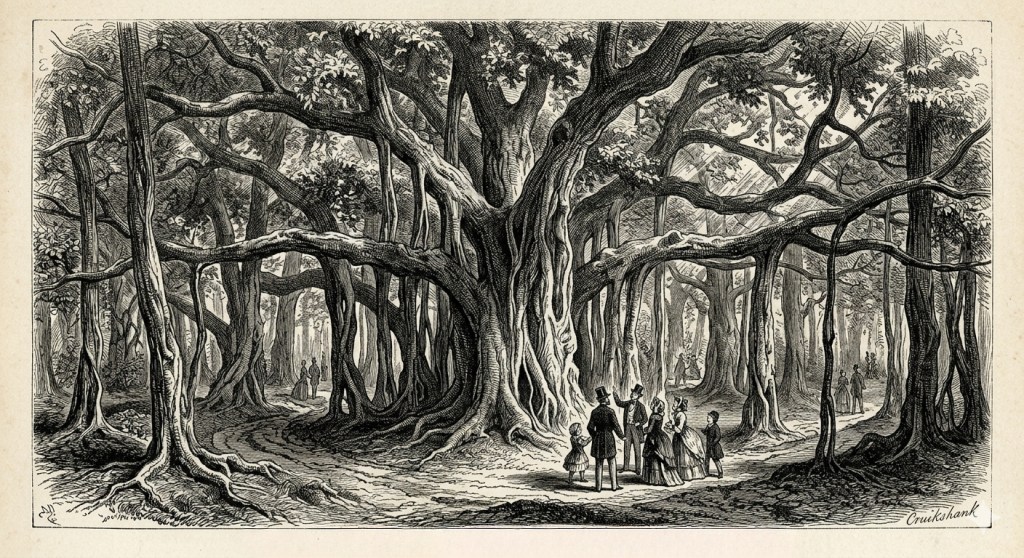
    The Great Banyan, Adayar, Chennai

    There is a particular kind of tree that refuses to behave like a tree. I want to be clear about this, because I think we all carry around a fairly reasonable mental image of what a tree is supposed to do. It is supposed to have a trunk. It is supposed to go up. It is supposed to have branches that extend outward at a respectful distance from the ground, like arms at a cocktail party, present but not imposing. There should be leaves. There should be shade. There should be a general agreement with gravity and with the basic social contract of vertical growth that most trees signed millions of years ago and have, for the most part, honored without complaint. The banyan tree on the grounds of the Theosophical Society in Adyar, Chennai, has other ideas.

    It does not so much grow as spread. It moves sideways the way a rumor moves through a small office, slowly at first, then with a kind of ambient inevitability that makes you realize, too late, that it has already reached the far wall. It sends down roots from its branches, which is a thing that trees are technically allowed to do but which most trees have the decency not to attempt. These roots descend like slow-motion anchor lines, and when they reach the ground, they thicken, and settle, and begin, over years, over decades, to resemble trunks of their own. Until you are standing under what you believed to be one tree and you realize you are inside something closer to a small, self-governing forest that has been operating under a single canopy this entire time, without telling anyone.

    In addition to being 500 years old, the whole thing covers something like two acres. Two acres. Of tree.

    My childhood apartment in Chennai was five hundred and twenty square feet. For most of my life, I believed this was generous. The banyan tree in Adyar is roughly one hundred and sixty times the size of my childhood apartment, and it has never once had to explain this to a real estate broker or pretend that the bathroom was a “spa-inspired alcove.” So there is that.

    You do not approach this tree the way you approach a tree. You approach it the way you approach a building that has been described to you by someone who was clearly not telling you the whole story. There is a moment, just before you walk under the canopy, where your brain is still insisting that you are about to look at a tree, and then there is the moment after, when your brain quietly abandons that project and begins searching for a better category. It does not find one.

    Because the banyan does not greet you as an object. It greets you as an environment. You walk into it the way you walk into a shaded courtyard in a city you are visiting for the first time. There are paths, though no one seems to have planned them. There are pockets of light that fall through the canopy in a way that feels deliberate but probably isn’t, or probably is, or honestly, after a few minutes inside the tree, you lose your confidence about what is deliberate and what isn’t, and this turns out to be part of the point. There are branches that lower themselves just enough to make you feel as though the tree is, in a polite and understated way, paying attention to you. Acknowledging you. The way a very old host acknowledges a guest at a dinner party, warmly but without the slightest suggestion that your arrival has changed anything about the evening.

    And then, after a few minutes, a thought arrives. This thing has been here for a while.

    Not in the casual sense of “a while,” the way someone says, “Oh, I’ve been waiting a while,” when they mean eleven minutes. But in the more serious, geological, slightly vertigo-inducing sense. The kind of “a while” that includes the rise and fall of governments, the invention and abandonment of entire philosophies, festivals that were celebrated for centuries and are now footnotes, renovations that were considered essential at the time and have since been quietly demolished, and ideas, great, confident, well-funded ideas, that seemed permanent when they were introduced and have since been retired with the gentle discretion of a waiter removing an untouched plate.

    The tree has been here for all of it. The tree does not appear to have opinions about any of it.

    At some point in the late 1980s, during a cyclone, the central trunk collapsed. Now, let’s sit with this for a moment. Because for most trees, for virtually all trees, in fact, and for most buildings, most organizations, most things that have a center and depend on it, this would be the end of the story. The trunk is the tree. The trunk goes, and then the branches go, and then whatever was nesting in the branches goes, and then someone arrives with a chainsaw and a municipal work order, and that is that.

    The banyan treated the collapse of its central trunk the way a large family treats the news that the kitchen is being renovated. There was a period of adjustment. Certain things were rearranged. But dinner was still served.

    Because the banyan, and this is the part that begins to matter in ways that extend well beyond horticulture, had already been sending down those secondary roots for decades. Hundreds of them. They had already reached the ground. They had already thickened into pillars. They had already, quietly and without issuing a press release, taken on the structural work of holding the whole thing up. So when the central trunk fell, the system around it was already doing most of the work. The fallen sections were propped up by what remained. New growth extended from old branches. And what had once been the center of the tree became, over time, simply another part of the system, no more important, and no less, than anything else.

    The central trunk collapsed. The tree did not.

    I realize I may be making this sound like the tree had a plan. It did not have a plan. Trees do not have plans. Trees have structures. And the structure of this particular tree meant that the loss of its most visible, most central, most apparently essential component was not the catastrophe it would have been for almost anything else. Which is, if you think about it, a hell of a thing.

    Because most of the things we build are not designed this way. And I am not just talking about buildings, though buildings are a fine example. I am talking about companies, and teams, and relationships, and systems of every kind. They depend on something. A central component. A key person. A founding assumption. A primary structure that quietly carries more weight than everything around it, and that everyone agrees is load-bearing, even if no one has recently checked whether this is still true. When that thing fails, when the key person leaves, when the central assumption turns out to be wrong, when the primary structure cracks in a storm that was not in the forecast, the rest of the system tends to follow it, politely but decisively, to the ground. We know this. We have all seen this.

    And so, when something breaks, the instinct is immediate and nearly universal. Find the damage. Identify the crack. Fix it. Reinforce it. Do something. Do it quickly. Do it visibly. Show everyone that the damage has been acknowledged and that corrective action is underway. Issue the memo. Call the meeting. Announce the plan. Do not, under any circumstances, stand there looking calm, because someone will mistake your calm for indifference, and in a crisis, indifference is the one thing nobody will forgive. This is, in fairness, often the right instinct. Things break. Things need fixing. Speed matters. But sometimes, and this is the part that is difficult, and interesting, and slightly maddening, sometimes the speed is the problem.


    During the Second World War, the United States military was losing bombers at a rate that was, to use the technical term, not good. Planes were going out on missions over Europe and not all of them were coming back, which is the kind of problem that generates a certain institutional urgency. The planes that did come back, however, were covered in bullet holes. And because the military was, among other things, an organization staffed by people who were very good at looking at problems and solving them, engineers began studying the patterns. They mapped the damage. They noted where the bullet holes clustered, across the wings, along the fuselage, near the tail gunner’s position. And they reached a conclusion that felt entirely, inarguably reasonable. Reinforce the areas that are taking the most damage. Add armor where the holes are. It was a clean answer. It was direct. It was responsive. It was the kind of answer that, in a meeting, earns a nod from everyone at the table, because it has the satisfying quality of seeming both obvious and actionable, which is the combination that most answers in most meetings are trying to achieve.
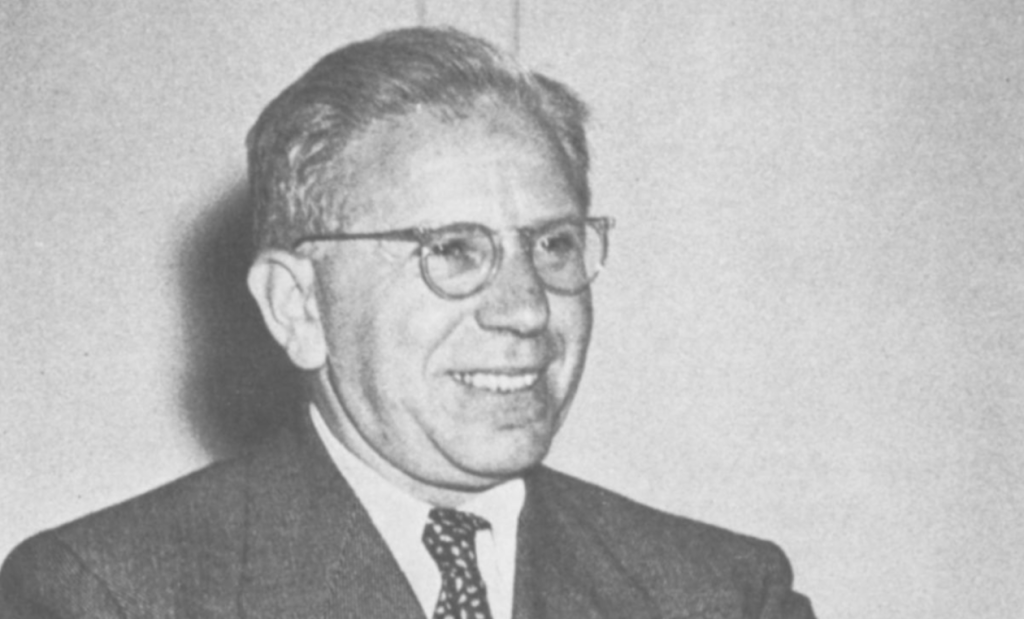
    Abraham Wald

    A statistician named Abraham Wald, a man who had fled Austria, who had lost most of his family to the war, and who had the particular, occasionally inconvenient gift of seeing what was not in front of him, suggested something slightly less intuitive. He proposed reinforcing the areas where there were no bullet holes.

    There must have been a silence in the room. I like to think there was. The kind of silence that follows a statement so unexpected that the people hearing it need a moment to rearrange their assumptions before they can respond.

    Because Wald had realized something that the engineers, in their speed and competence and entirely understandable desire to solve the problem, had missed. The planes they were studying were the planes that had survived. The bullet holes they were mapping were the bullet holes that had not brought the planes down. The areas riddled with damage were, by definition, the areas where a plane could take a hit and still make it home. The places where there were no bullet holes? Those were the places where planes were getting hit and not coming back at all. The damage the engineers were reacting to was the damage that had already been survived. The real vulnerability, the thing that was actually killing planes, was missing from the data entirely. It had removed itself from the sample by destroying the planes that carried the evidence.

    I have thought about this more than I probably should. Not about planes. About the pattern. Because it is an unsettling kind of mistake. Not because the reasoning was careless, it wasn’t. The engineers were careful, and educated, and working under enormous pressure with the best information available to them. The mistake was not laziness. It was not stupidity. It was speed. The system reacted to what it could see. It looked at the evidence in front of it, and it moved quickly to address the most visible problem, and in doing so, it very nearly optimized for the wrong thing entirely. It almost spent its limited resources reinforcing the parts that were already strong, while leaving the parts that were actually failing completely unprotected.

    Most of us would recognize this. Not from the Second World War. From Tuesday. From every meeting where the most vocal complaint got the most attention. From every organization that restructured itself around the most visible problem and missed the one that was quietly hollowing out the foundation. From every moment in my own life when I rushed to fix the thing I could see and ignored the thing I couldn’t, because the thing I could see was right there, demanding to be addressed, and the thing I couldn’t see had the decency to be invisible, and I mistook its invisibility for absence. This is what we do. We react to signals. We respond to what is in front of us. We move quickly, because the situation seems to demand it, and because moving quickly feels like competence, and because standing still feels like failure. And sometimes, not always, but more often than we would like, we reinforce the wings.


    The banyan tree does not seem to make this mistake. When its trunk collapsed, it did not rush to rebuild what was lost. It did not concentrate its resources on restoring the visible center. It did not reorganize itself around the damage, or convene an emergency meeting of its branches, or issue a statement about its commitment to structural integrity going forward. It continued with the structure it already had. Distributed. Redundant. Quietly, almost maddeningly indifferent to the idea that any single part of itself, including the part that had, for centuries, looked like the most important part, needed to be preserved at all costs.

    Which means it did not have to decide, in the moment of crisis, what the problem was. It did not have to interpret the shock correctly. It did not have to figure out, under pressure and with incomplete information, which part of itself to reinforce and which to leave alone. It did not have to react.

    And I think this is the part that is actually worth sitting with. Because the banyan’s advantage is not intelligence. It is not awareness. The tree does not know anything, in the way that we understand knowing. It cannot analyze damage, or assess risk, or read Abraham Wald’s paper and draw the appropriate conclusions. Its advantage is that it is structured in a way that makes immediate reaction unnecessary. It does not have to respond quickly, because it has already, over centuries, built a system that absorbs shocks without needing to understand them. It does not have to diagnose the problem, because the architecture itself is the diagnosis, redundant, distributed, designed (or evolved, or arrived at, or whatever the right word is for something that a tree does without deciding to) so that no single failure can cascade into a total one.

    It does not respond quickly. It responds over time. And by the time it has responded, the system has already absorbed most of what happened, the way a very large body of water absorbs a stone. There is a ripple. The ripple travels. And then the surface is calm again, and the water is still there, and the stone is at the bottom, and nobody is entirely sure when the ripple stopped.

    The tree’s answer, of course, is not available on demand. You cannot decide on Sunday to become a banyan and expect to survive next week’s cyclone. The roots take time you do not have. The redundancy costs resources you are already spending on the visible damage. This is not advice. This is not even consolation. It is only a description of what a durable shape looks like from the outside, after the fact, when you are standing in the shade of something that had the luxury of becoming itself slowly.

    You leave the tree eventually, because that is what visitors do. You step out from under the canopy, and the light changes, and the air changes, and you are back in a world that operates on a different schedule. Outside, things behave more urgently. Decisions expect to be made by end of day. Problems arrive with the implicit message that they are the most important problem you will face this week, until the next one arrives tomorrow and supplants them. Signals come at you from every direction, some meaningful, some not, most of them indistinguishable from each other in the moment, and they all seem to demand a response. It becomes natural to respond to them. Quickly. Directly. Visibly. In ways that demonstrate you have identified the damage and are already, heroically, reinforcing the wings.

    The tree continues behind you. It is not especially concerned with what just happened. It is not particularly interested in reacting to it. It is extending itself, as it always has, one root at a time, in ways that will make whatever shock comes next slightly less important than it first appears.

    I think about the engineers, mapping bullet holes on surviving planes, so certain they were solving the right problem. I think about Wald, quietly pointing at the empty spaces and saying, no, look here. I think about every time I have rushed to fix the visible thing and missed the invisible one, and every time the visible thing turned out to be the wound that was already healing, and the invisible one turned out to be the wound that mattered. And I think about the tree. Not because it has the answer. It’s a tree. It doesn’t have answers. It has roots. But it has a lot of them. And they are everywhere. And when the center fell, they held.

    We tend to react to what we can see. The systems that last are often the ones that don’t have to.
  • April 6, 2026

    wingbeat wingbeat

    i wake before the light
    because the light is late
    and i have things to say

    all night the branch held me
    thin as a thought
    but morning

    morning splits

    green everywhere
    green pushing through wood
    through soil
    through memory

    i shake myself loose
    feathers crackle
    the sky opens

    and i cannot hold it

    i sing

    trill-trill-trill
    see-see-see
    bright-bright-bright

    i throw my throat into the air

    here i am
    here i am
    here i am

    the worms wriggle
    the puddles flash
    the sun leans closer

    and i sing again

    not pretty
    not polite

    loud
    sharp
    spilling

    tree-to-tree
    roof-to-roof
    sky-to-sky

    i slice the blue and shout through it

    spring!
    spring!
    spring!

    the branches answer in leaf
    the grass answers in green
    the air answers by lifting me

    everywhere something is trying
    grass trying
    insects trying
    the sun trying

    and i join the trying

    wingbeat
    wingbeat
    wingbeat

    my heart hammers
    hammer-hammer
    faster

    joy rising in my throat
    too big
    too bright

    i pour it out

    chirrup
    whistle
    cry

    again

    again

    again

    yesterday the world was bone

    today

    today

    it breaks into bloom

    and i am not quiet about it

    i am noise
    i am feather
    i am breath on fire

    i survived the cold

    and now

    now

    i get to sing

    and fly

    and sing

    and fly

    and sing

    again


    author’s note

    on walks during april mornings, you start to hear them. rowdy songbirds, completely unbothered by your plans, yelling as if silence has personally offended them. they interrupt your calls. they do not lower their voices or wait their turn. this is a declaration, not a performance.

    they are small. i still can’t identify them, despite owning two field guides i have never opened past the introduction. they are loud. startlingly, almost confrontationally loud. they sing like quiet is unacceptable.

    most small songbirds live two to five years. their hearts beat somewhere between three hundred and five hundred times per minute, which is an unreasonable amount of effort just to stay alive, and yet they manage it while also flying, singing, and looking perpetually startled. if you or i operated at that metabolic rate, we would need to eat roughly our body weight in food each day, which, now that i think about it, i may have attempted during certain winters.

    the bird does not know any of this. it only knows that the air is warm and the throat is full.

    i wanted to write from inside that. no perspective, no wisdom. just the body doing what sixty million years of evolution built it to do.

    somewhere in there i thought about jonathan livingston seagull flying for the stupid glory of flying, nelly furtado’s i’m like a bird refusing to stay in one place, and rahman’s phir se us chala, which does in four minutes what most therapy does in four years.

  • April 4, 2026

    Fluency, Interrupted

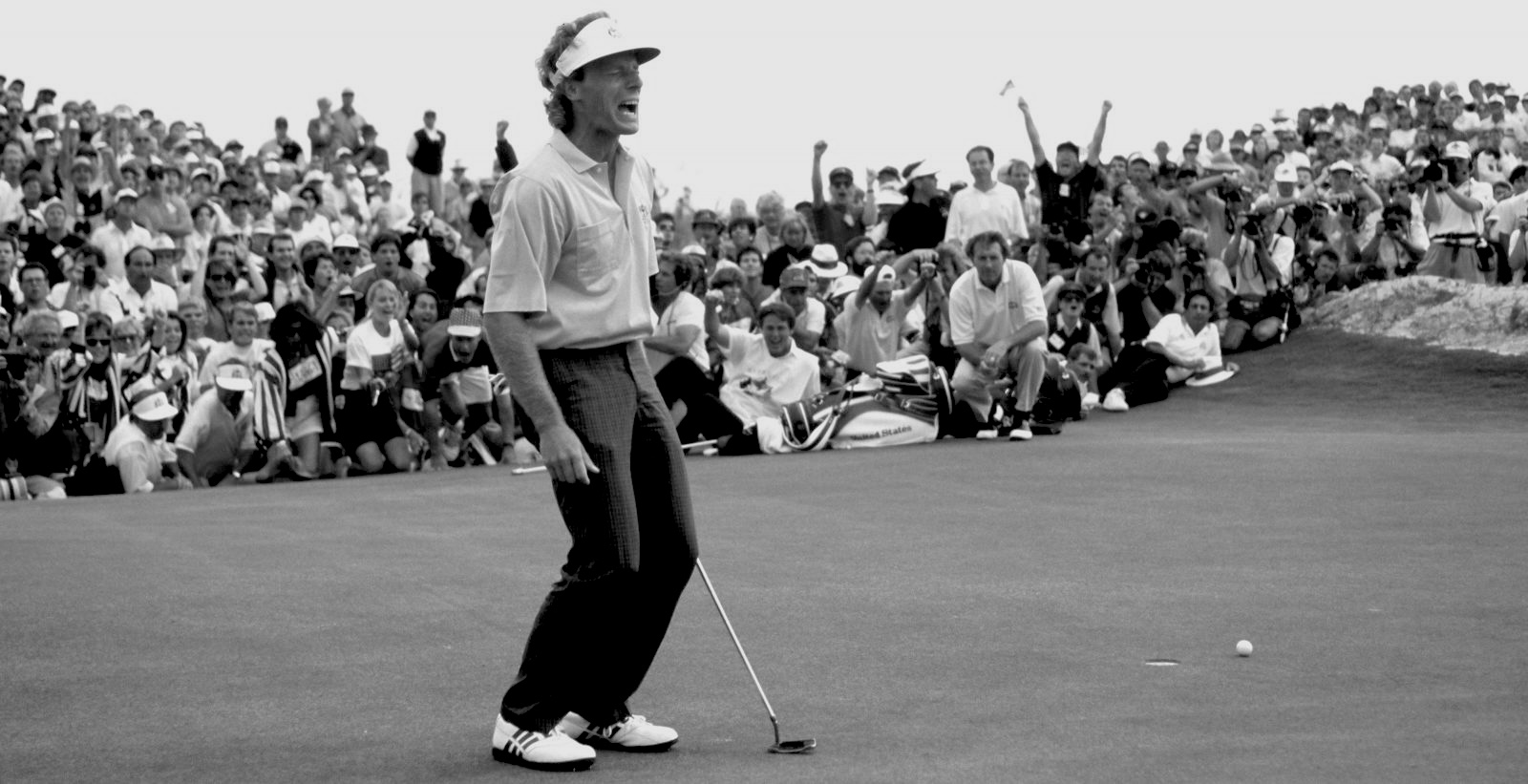
    In September 1991, at the Ryder Cup on Kiawah Island, Bernhard Langer stood over a putt he had made thousands of times before and could not trust himself to make now. It was the sort of distance that professional golfers do not ordinarily regard as a problem. They have made putts like this so often that the act barely qualifies as a decision. The body knows what to do. Six feet, after all, is not very far. It is two unhurried steps. The match, and with it the Ryder Cup, rested on the stroke. Which is why what happened next was so bewildering.

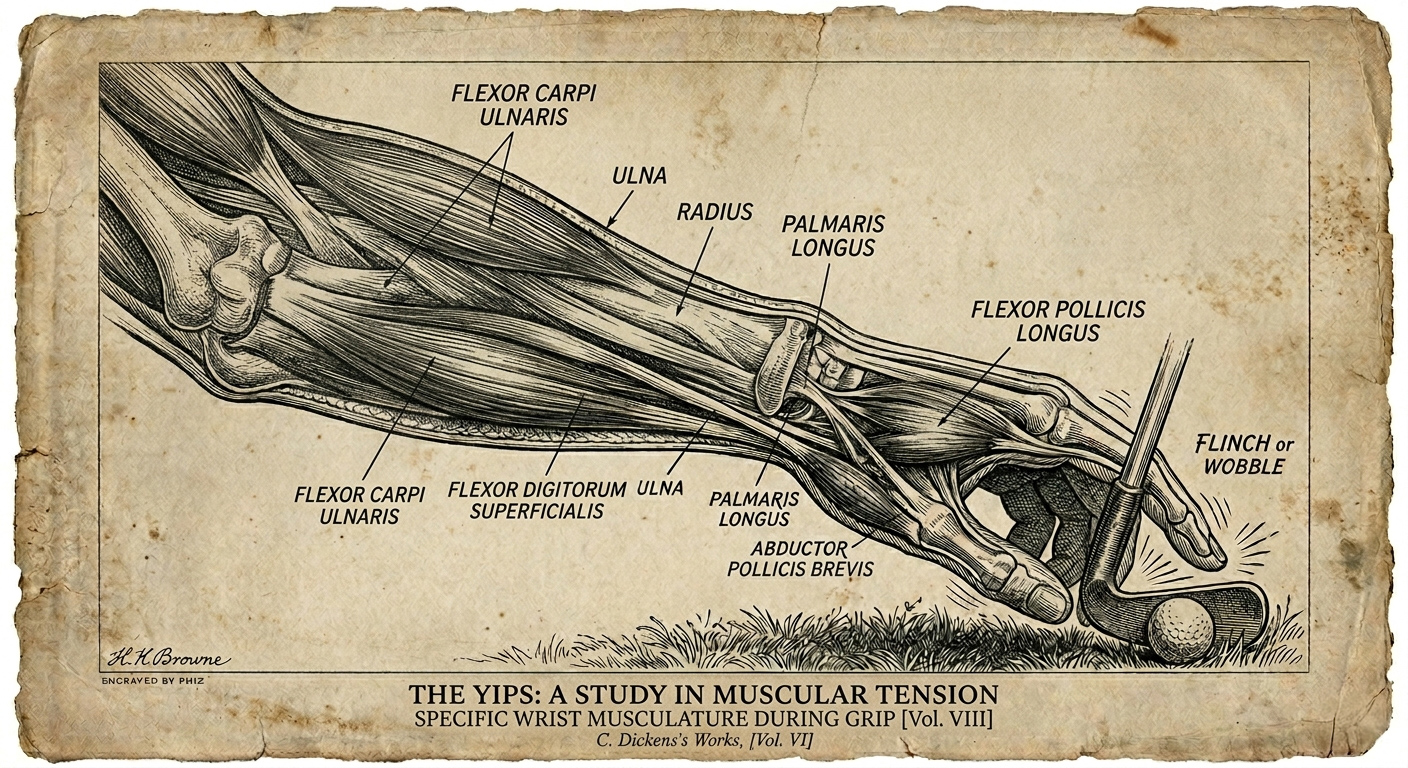
    Langer settled over the ball, drew the putter back, and then his hands did something that hands are not supposed to do. They flickered, a tiny involuntary spasm, like a flinch at a noise that had not come. The putter jerked. The ball wobbled off its line and slid past the hole with the apologetic air. Langer stared at his hands as though they belonged to somebody else.

    In golfing circles the condition has a name. They call it the yips. It is a small, faintly comic word for what is, by all accounts, a deeply harrowing experience, the sudden inability to do the thing you have spent your entire life learning to do supremely well. Which raises an interesting question. How does a person forget something they never had to remember in the first place?

    You can try this yourself. Say your name out loud. Now say it again, but this time pay attention to how your tongue moves, where it touches your teeth, how the sound is formed. The second version is usually worse. Slightly slower. Slightly less natural. Something that required no effort a moment ago now feels faintly mechanical. Nothing has been forgotten. Something has been interrupted.

    The yips are not confined to golf, though golf seems to suffer from them disproportionately, in the way certain families are disproportionately afflicted by bad luck or unusual dental arrangements. Baseball players get them. Cricketers get them. Pianists get them, seizing up on passages they once played effortlessly. Even darts players get them, which must be particularly annoying when you consider that the entire biomechanical demand of the sport is a single controlled flick of the wrist. 

    For a long time the yips were treated as a psychological curiosity. But neuroscience, which has a habit of making the mysterious seem merely complicated, offers a clearer picture. The brain, like any good organization, has departments.

    Consider something simple. Walk across a room. You do not plan each step. You do not issue instructions to your knees. You do not negotiate with your ankles. And yet you arrive, more or less upright, without incident. This is the work of the basal ganglia, a cluster of structures buried deep in the cerebral interior, quietly sequencing movements into smooth, automatic routines. They run the factory floor. They are not glamorous. Nobody writes poems about the basal ganglia. But they are extraordinarily good at their job. 

    Now try walking again, but this time pay attention to each step. Notice where your foot lands. Consider the angle of your knee. Think about balance. The experience becomes slower, slightly awkward, faintly unnatural. You may not fall over, but you will not glide. Something has entered the system.

    Behind the scenes, the cerebellum, tucked at the back of the skull like a small decorative cauliflower, is handling timing and calibration, the difference between a movement that is slightly off and one that is exactly right. It makes quiet corrections you never notice, like a stagehand adjusting the lighting during a play. And then there is the prefrontal cortex, sitting just behind the forehead, concerned with planning, reasoning, and what neuroscientists delicately call executive function. It is the management layer. It decides what to do, monitors whether it is being done correctly, and worries about what might go wrong.

    Here is the critical thing. When you are very good at something, when you have practiced it thousands of times until it feels natural, the movement runs almost entirely through the basal ganglia and cerebellum. The prefrontal cortex, having done its work during the long years of learning, steps back. It trusts the system. It goes upstairs and reads the newspaper. Elite skill lives below conscious awareness.

    The yips begin, or at least one persuasive theory suggests they do, when the prefrontal cortex decides to come back downstairs. Neuroscientists call this reinvestment, which is a characteristically dry term for what amounts to a hostile management takeover. The conscious mind, for reasons that may involve pressure, anxiety, or simply a bad Tuesday, begins supervising a process that was running perfectly well without supervision.

    The golfer starts thinking. Keep the wrists steady. Do not decelerate. Stay square. These are sensible instructions. The problem is that the conscious mind delivers them in the wrong language. Conscious thought is slow, analytical, and sequential, processing one thing at a time like someone reading aloud from a manual, while motor execution is fast, automatic, and parallel, processing many signals simultaneously like an orchestra playing from memory. When the manual reader tries to conduct the orchestra, the result is not improved precision. The result is chaos.

    For Bernhard Langer, what followed was a private ordeal conducted in the most public of settings. Golf gives its participants an almost cruel amount of time to think. A tennis player who mishits a serve can immediately hit another. A footballer who misplaces a pass is swept along by the flow of play. A golfer must walk to the ball, stand over it, and execute a movement lasting roughly one and a half seconds, all while several thousand people watch in silence. For a person with the yips, this silence is not helpful. 

    Langer tried everything. He changed his grip repeatedly. He practiced obsessively. He searched for control. None of it worked. The problem was not ignorance. The problem was interference. Trying harder only increased the interference. Trying harder was the disease.

    The solution, when it came, was structural. Langer switched to a long putter. Instead of relying on the small stabilizing muscles of the wrists and fingers, precisely the muscles most vulnerable to tremor, the long putter shifted control to the larger muscles of the arms and shoulders. The movement changed. The system changed. The brain adapted. The yips did not transfer. Years later, when anchoring was banned, Langer adapted again. He did not overpower the problem. He redesigned it.

    Once you see this, it becomes difficult to unsee. Consider writing. A sentence begins easily enough. Words arrive in the right order. The rhythm feels natural. Then, somewhere in the middle, another voice enters. Is this the right word? Should this be shorter? Is this sentence too long? The hand slows. The sentence stiffens. What was fluid becomes deliberate. What was obvious becomes uncertain. The sentence was fine. Then the mind showed up.

    Something similar happens in other systems that appear to run smoothly on their own. A rhythm develops. Decisions move quickly. Actions follow one another without much friction. And then, gradually, attention gathers around the process. It is examined more closely. Steps are noticed that had previously gone unnoticed. Explanations begin to accompany actions. Nothing fundamental has changed. And yet the movement feels different. The system does not fail. It hesitates.

    The brain works in layers. The prefrontal cortex supervises. The deeper systems execute. The arrangement works beautifully, provided the supervisor knows when to step aside. The yips are what happen when it does not. The mind begins watching a process that cannot perform while being watched.

    Bernhard Langer is now in his late sixties. He still competes. He has won more tournaments on the senior tour than almost anyone in history. His story suggests something worth remembering. The skill is still there. The problem is not ability. The problem is attention. Fluency lives below supervision.

    The mind, after all, possesses the remarkable ability to interrupt its own intelligence.

  • March 28, 2026

    The Line No One Drew

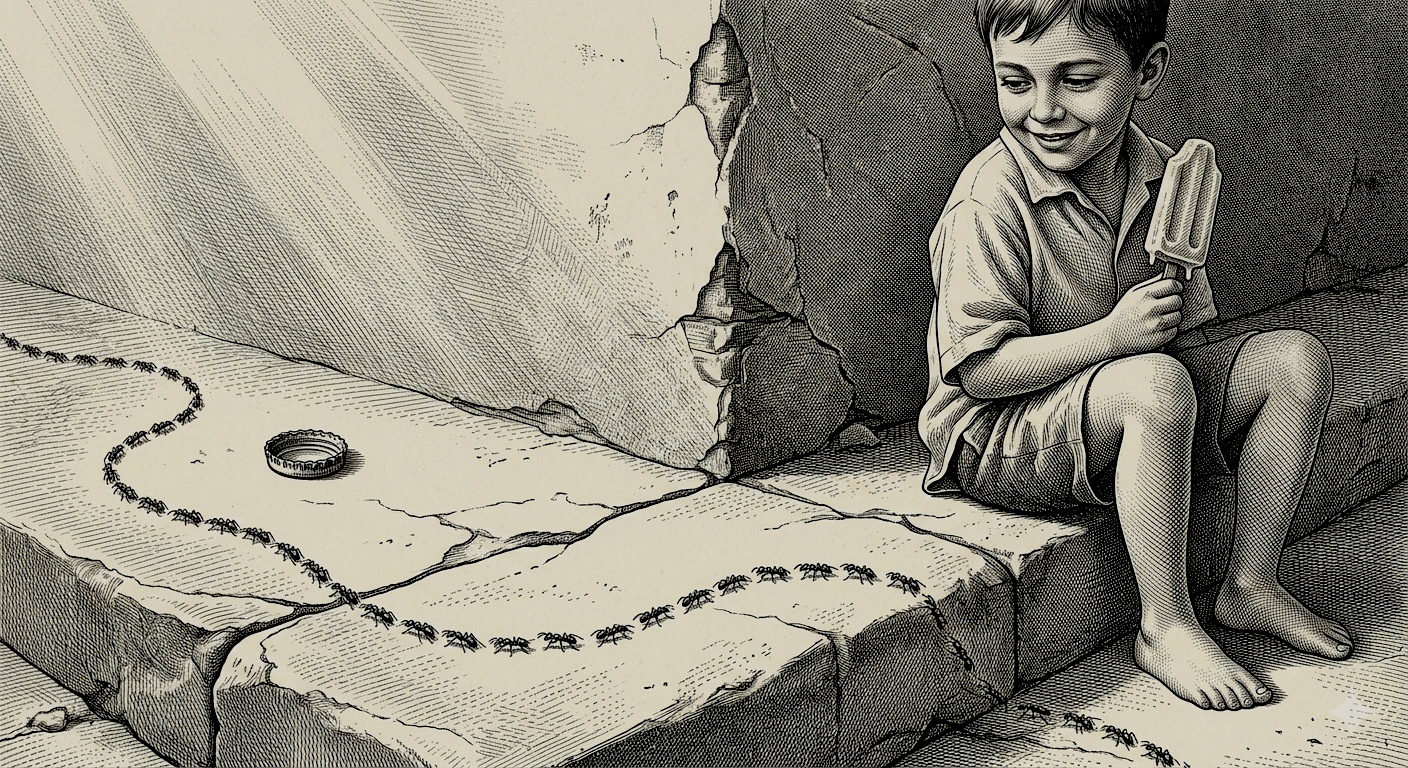
    Have you ever noticed how ants move in a perfect line to a place no one told them about and back again, as if they had been given directions by someone extremely small and extremely bossy? It is usually midday when you notice them. The kind of heat that flattens everything except the things that refuse to be flattened, which, it turns out, includes ants. You are six, or eight, or ten. Childhood being less a timeline than a rough suggestion. You are supposed to be doing something else. You are always supposed to be doing something else. But instead you are crouched near a wall, watching a procession that appears to have an appointment it cannot miss.

    They come out of a crack you have walked past a thousand times without once thinking about it. One after another, with a solemnity that seems, frankly, a bit much for creatures you could defeat with your thumb. Sometimes they are the small black ones. Though at the time you would have called them the ‘boring ones’ and gone back to your popsicle. Sometimes they are the red ones better known as fire ants, which you learn about not from a book but from standing in the wrong place at the wrong time in a pair of sandals, an experience that stays with you in the way that only very small, very painful mistakes can. And occasionally there is a larger black ant. The carpenter ant, built like it was sent from a different department entirely, with the kind of jaw that suggests it does not just bite but holds a grudge.

    But regardless of species or temperament, they all do the same thing. They form a line. 

    A line. It stretches from nowhere in particular to something that has suddenly become the most important thing in the world. A crumb. A sticky spot on the concrete. A fragment of something you dropped and immediately forgot about but which has, apparently, made someone’s entire afternoon. And then, just as neatly, they turn around and go back the way they came, like very tiny commuters who all happen to work at the same office. It does not look accidental. It looks like someone is running things.

    At some point you wonder how they know. Is there something they can see that you cannot? Is there a path already there, drawn in some ink visible only to ants? Is there, somewhere in the colony, a very small cartographer with a very small desk? There is not. They are following each other. Or more precisely, they are following what the others left behind.

    The path is not there when the first ant sets out. It is made. Here is what actually happens, and it is both less and more impressive than you would think. An ant wanders. It does not know where the food is. It does not know there is food. It moves, stops, turns, doubles back, makes a series of small, unremarkable decisions that, taken individually, look exactly like being lost. Most of those decisions lead nowhere. This is not a failure. This is a workday, if you are an ant. 

    Then, by accident or persistence or the kind of dumb luck that occasionally changes everything, one of them finds something worth carrying home. On the way back, it leaves a trace. It’s just a faint chemical mark, a pheromone, laid down in passing, the way you might leave a fingerprint on a glass door without meaning to. The next ant that happens upon that path is slightly more likely to follow it. Not certain. Just nudged, in the gentlest possible way, toward a direction that might be worth trying. That is enough.

    Here is where it gets elegant, and I use that word deliberately, because what follows is one of the tidiest bits of math in the natural world. If the path is short, ants traverse it quickly. Faster trips mean more ants walking the same route in less time. More ants mean more pheromone. More pheromone means the next ant is even more likely to follow. The path thickens, simply because it is being used. A loop forms. A beautiful, brainless, self-reinforcing loop. More use strengthens the path. A stronger path attracts more use.

    Meanwhile, other ants are still out there wandering, the way other ants do, and some of them stumble onto alternative routes. If one of those routes happens to be shorter, it begins to accumulate pheromone faster, because shorter path, quicker trips, more ants, more trace. The system does not pause to weigh its options. It does not convene a panel. It simply allows one path to outcompete another, quietly and without fanfare, the way the better restaurant on the block eventually gets the longer wait. And then, just as quietly, the losing path fades. The pheromone evaporates. No one removes it. No one sends a memo saying we have moved on. It simply weakens unless it is continually refreshed. What remains is not what was once discovered but what continues to be worth discovering.

    This is the entire method. The whole thing. To put it plainly: Wander enough to find something. Reinforce what works. Let everything else disappear. No ant sees the whole picture. No ant decides. No ant even knows there is a problem being solved. Not one of them could tell you, if you asked, what the colony is doing or why. And yet, if you watch long enough, the line becomes cleaner. Straighter. More certain. It begins to look, from a distance, like someone planned it. No one planned it. It is accumulation, pretending to be intelligence. Which, when you think about it, describes rather a lot of things.


    In the early 1990s, an Italian computer scientist named Marco Dorigo was watching ants or, more precisely, thinking about ants, which is a different activity but an equally productive one, and he noticed that this small, quiet process could solve a problem that is neither small nor quiet. Mathematicians call it the Traveling Salesman Problem, and it goes like this: given a number of cities, find the shortest route that visits each one exactly once and returns home. It sounds simple. It is not simple. Add enough cities and the number of possible routes grows so large that the sun would burn out before you finished checking them all, which is the sort of fact mathematicians enjoy sharing at parties.

    Dorigo did not improve the ants. He copied them. He built a computer simulation full of simple little agents, digital ants, essentially, each one making small, slightly biased decisions, each one leaving behind traces that the others were slightly more likely to follow. Shorter routes accumulated more reinforcement. Longer ones faded. No agent understood the problem. No agent needed to. Run it enough times, and the system began to converge on efficient paths. Not because it grasped the mathematics. Because it kept making the same mistake less often, which, if you think about it for even a moment, is a pretty decent working definition of learning.

    What Dorigo formalized was not an insect trick. It was a coordination pattern, and it has exactly three moving parts. Local decisions. Shared traces. Decay. No meeting is held. No one understands the whole. And yet the system improves. The intelligence is not in the agent. It is in the feedback loop.

    And the most important part of that loop, the part that makes the whole thing work, is not reinforcement. It is forgetting. Without evaporation, the system would fall in love with its first decent idea and never look at another one. The earliest workable path would thicken into gospel. Exploration would stop. Mistakes would harden into tradition.  With evaporation, the past stays provisional. A path survives only because it continues to earn its place. Not because it was once correct. Because it still works. There is something almost unsettlingly fair about that.


    You can see the same pattern well beyond the anthill, once you start looking. Inside a company, a weekly report begins as a way to track something that genuinely matters. The first version is useful. The second is expected. By the third it is required. Over time, the report grows longer, more careful, more elaborately formatted. People spend hours on it. It acquires a template. The template acquires a style guide. Someone suggests adding a cover page. No one remembers exactly why the report exists. But it continues, because it has always continued. A hiring practice works once, then twice, then becomes policy. A metric correlates with success, then becomes success. A slogan resonates, then hardens into identity. These things happen so gradually that by the time you notice, the thing that was once a useful path has become the only path anyone can imagine taking.

    Reinforcement, left unchecked, puts on a very convincing costume and calls itself principle. New ideas still appear, of course. They show up at the edges, the way they always do. Some are tried. Most fail quietly. A few work. Those are repeated. Repetition becomes legitimacy. Legitimacy becomes structure. And then, if nothing interrupts the cycle, if there is no evaporation, no forgetting, no willingness to let a path fade, structure becomes the thing that people mistake for the floor, when really it is just a very old carpet that no one has lifted in years.

    In ant colonies, evaporation is automatic. Built in. Non-negotiable. The chemistry handles it. In human systems, it is resisted with an enthusiasm that borders on the religious. Practices remain long after the conditions that created them have changed. Rules persist because they once made sense, and ‘because we have always done it this way’ is the world’s most durable sentence. Institutions remember more easily than they forget, which sounds like a compliment but is not, necessarily. It is another way of saying they learn unevenly. They are very good at accumulating and very bad at letting go.

    Culture does not learn by understanding. It learns by repetition.

    Look again at the blue driving line on your phone’s map. It looks authoritative. Decisive. Clean. As if someone, someone very competent, someone with a clipboard and strong opinions about efficiency, has examined every possible route and chosen the best one, just for you. But the line was not chosen. It was accumulated. Every driver who slowed down, every car that moved quickly, every moment of hesitation at an intersection left behind a kind of trace. None of them were trying to help you. None of them saw the whole picture. Most of them were just trying to get home, or to the dentist, or to pick up their kids, and were not thinking about you at all. But together, without meaning to, without coordinating, without even knowing about each other, they shaped a path. 

    The line exists because it has been walked. And like the ants’ trail, it remains only as long as it continues to be walked. When traffic builds, cars slow down. That slowing becomes a signal. Enough of those signals, and the route no longer appears efficient. Fewer drivers are routed through it. The trail begins to thin. Somewhere else, a slightly faster path begins to thicken. No announcement is made. No explanation is offered. No one from the mapping app sends you a note saying, sorry, we have changed our minds. The system does not decide. It shifts.

    What survives repetition becomes reality.

    And if you have read this far, you may be starting to suspect that the difference between a colony of ants finding the shortest path to a breadcrumb and a civilization finding its way to an idea is mostly one of scale. You would not be entirely wrong.

  • March 21, 2026

    The Height of Belief 

    I have asked a few celebrities questions in my life, which is already more than I would have predicted for myself, and almost all of them have been answered with admirable patience. There was one exception.

    This was during the shooting of Guna. I was twelve, maybe thirteen, which is the age at which you are old enough to be curious and young enough to be completely unembarrassed about how badly you express that curiosity. He had just finished a shot. People moved around him with that quiet efficiency that suggests everyone knows exactly what to do except the people who don’t. He didn’t need to say much. Things seemed to arrange themselves.

    His car was waiting. A Contessa, which at the time felt like the official vehicle of people whose lives were going much better than yours. A small crowd gathered. Autographs began. Notebooks appeared from nowhere. Someone produced a piece of paper that looked like it had once been part of something else and was now being promoted. And then I asked my question. It was not about the film he was shooting that day, which would have been sensible. Not about anything that could be answered quickly while a man is halfway between work and leaving. I asked him how he had done that role. How he had acted as a dwarf. It was not a good question. It was not even a complete one. It was the kind of question that arrives whole in the mind and falls apart on the way out.

    He looked at me. Not kindly or unkindly. Just… accurately. And then he reached out, gave a light tap on my cheek, and moved on. No answer. Not even the courtesy of a vague sentence that sounds like an answer but isn’t. Just a gesture that, at the time, I took to mean something like: this is not a question you can ask this way. The car door closed. The Contessa left.  I have told this story to an unreasonable number of people ever since, which is how you know it stayed.

    You eventually find yourself returning to that question in the only place it can be answered. In watching.

    When you start to watch a movie these days, it usually begins with a small act of caution. You turn on subtitles, not because you absolutely need them, but because it feels like the sensible thing to do. The language moves quickly. The voice has edges. This, you tell yourself, is temporary. A light assist. The cinematic equivalent of holding the railing on the way down a staircase you probably don’t need help with. The subtitles appear, dutiful and slightly officious. And then, somewhere in the middle of a scene, you realize you haven’t looked at them in a while. They have simply stopped being useful. A few minutes later, something else disappears. You are no longer thinking about anything. Not the actor or their reputation. Not even the faint internal checklist that usually accompanies a familiar face. There is no running commentary saying this is very good acting, or look at that choice, or this must have been difficult. There is just a person, in a situation, behaving in a way that makes sense.

    And then, like a delayed echo, the question returns, slightly rearranged: What does the actor’s real voice even sound like.

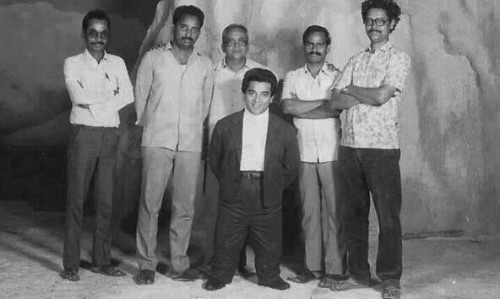
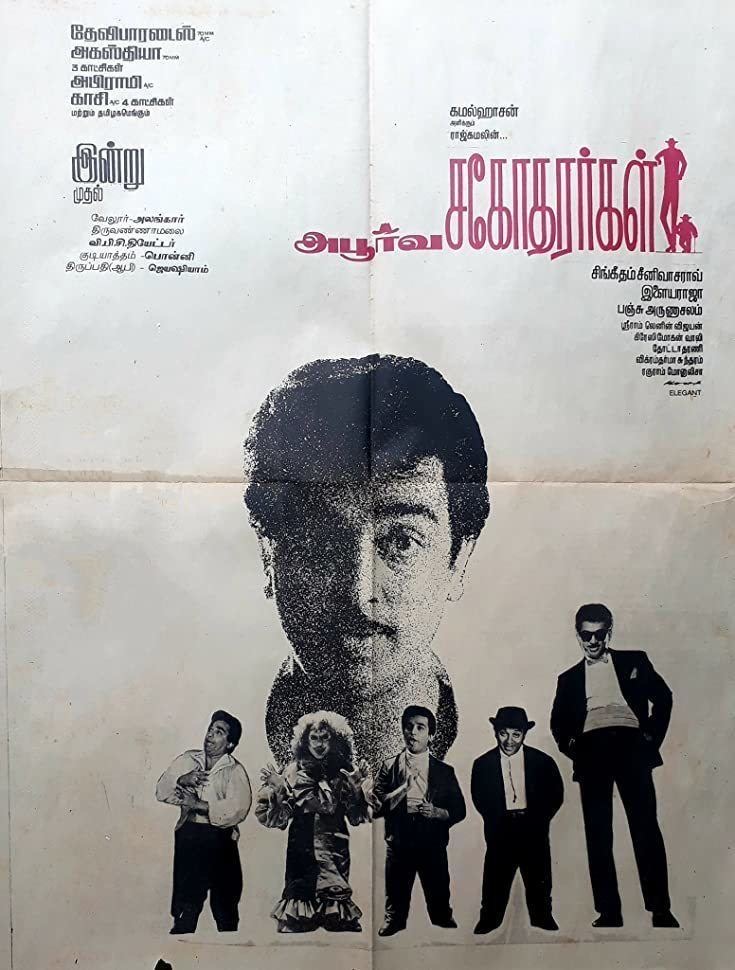
    The film is Apoorva Sagodharargal, a Tamil film from the late 1980s in which Kamal Haasan plays twin brothers, one of whom is a character with dwarfism and also, somewhat inconveniently for the production, the emotional and structural center of the story.

    This is not a cameo or a novelty. He is not appearing briefly to demonstrate that such a thing can be done. He carries the film. He moves through it constantly. He walks, reacts, jokes, falls in love, suffers, plans revenge, and occasionally dances, all while existing in a body that the frame has to accept without argument. One brother moves through the world at full height. Doors behave. Tables meet him where they should. Conversations require no adjustment. The other brother negotiates. The world sits slightly higher than expected. Faces require a tilt upward. Movement has to be recalibrated. Even standing still involves a small, ongoing correction that you are not supposed to notice. Both brothers share the same frame, but not the same physics.

    This is the late 1980s. There is no digital safety net waiting quietly in the background. No one is going to fix this later. No software is going to politely correct proportions or clean up a shadow that reveals too much. If something feels off, it stays off. If something breaks, it breaks permanently and for everyone. 

    Which is why, at first, you watch carefully. Of course you do. You notice the eyelines. You notice the framing. You notice how space is being managed. You are, in a very reasonable and slightly suspicious way, checking whether this is going to hold. And then, quite suddenly, you stop checking. It’s not because the problem has gone away. Because you no longer feel responsible for it.

    What makes this work is not one trick, but the refusal to allow even a single ordinary moment to fail.

    In frontal shots, Kamal Hassan moved on his knees, feet folded under, with specially built shoes strapped to them so that the walk had weight and rhythm instead of suggestion. In profile shots, where the illusion is least forgiving, trenches were dug into the studio floor so his real legs could disappear while the camera remained at a normal height. He practiced walking in those trenches until it no longer looked like balance, but movement. When the ground could not be cut, platforms were built. When he sat, his legs vanished into pits or were replaced with articulated ones controlled just out of frame. Eyelines were adjusted with boxes. Shadows were controlled with the kind of attention usually reserved for things audiences actually notice.

    All of this, so that nothing would be noticed.

    What’s unusual is not that the illusion holds. Many films manage that for a moment, and often very well. What’s unusual is that it becomes the only version of reality available to you. There is nothing left to compare it against. No alternative frame, no small inconsistency that invites inspection. The world behaves with enough internal consistency that the mind stops asking whether it is real and begins treating it as given.

    At that point, it stops behaving like a performance. And this is not what most performances attempt, and not what most could sustain. The difficulty is not in creating the illusion, but in maintaining it through the ordinary moments where attention drifts and systems usually reveal themselves. Here, those moments do not arrive. Once accepted, the question of how does not return.

    Because films do not live in their cleverest moments. They live in the in-between. In the walk that is not meant to impress you. In the reaction that happens before anyone has time to perform it. In the small, forgettable actions that quietly hold everything together. That is where belief is tested. And that is where it usually fails.

    A slight hesitation. A gesture that feels just a little too explained. A movement that seems to remember its instructions. These are small things, and pointing them out feels faintly rude, like noticing someone checking their reflection. But they accumulate. And once you see them, you are no longer inside the story. You are watching the effort.

    Which is when something slightly uncomfortable becomes clear. Most of the time, you are helping the film work. You overlook things. You smooth edges. You fill in gaps that are small enough to ignore but real enough to exist. You accept a convenient cut. You forgive a moment that arrives a little too neatly. You allow the film to become what it is trying to be.

    We call this watching. But it is, quietly, participation. In most films, belief is a shared responsibility. The filmmaker builds, the actor performs, and the audience completes. The system works because you are doing part of the work.

    What Kamal Haasan does here is remove your role from that system. Instead of making the problem smaller, he does it by absorbing it completely. His performance does not ask for your cooperation. It does not signal where you should be generous. It does not leave small gaps for you to bridge. It simply proceeds, as though nothing unusual is happening. And somewhere along the way, your job disappears.

    Which, in a way, answers the question I asked that day. Not with anything that could have been explained between autographs and a waiting car. But with something much less convenient. There isn’t a trick. There is only the work, done so completely that it leaves nothing behind for you to do.

    Some performances are impressive. Some leave you with nothing left to do.

    Epilogue

    In hindsight, my timing was spectacular in its incompetence. He was shooting the ‘Pentothal’ scene that day. The one where he circles the room in a state of manic, jagged prayer, banging on the walls as if the bricks themselves owed him an explanation. It is a scene that requires an actor to essentially unspool his own nervous system for the camera. To approach a man who has spent the last six hours vibrating with that kind of professional haunting and ask for a technical breakdown of a different movie is not just a bad question, it is a minor accidental cruelty. It is like asking a man who has just escaped a burning building whether he has any thoughts on the courtyard design of the Taj Mahal.

    The tap, I now understand, was gentler than I deserved.

1 2 3 … 317
Next Page→
  • about
  • archive
  • all that is
  • photoblog
 

Loading Comments...
 

    • Subscribe Subscribed
      • kirukkal.com
      • Join 26 other subscribers
      • Already have a WordPress.com account? Log in now.
      • kirukkal.com
      • Subscribe Subscribed
      • Sign up
      • Log in
      • Report this content
      • View site in Reader
      • Manage subscriptions
      • Collapse this bar